
Engineering
How did Pixelstorm solve the hard production equation? Advanced cinematic quality with cloud flexibility and stable in-house engineering
The world of television and film production has seen a revolution driven by Virtual Production and Extended Reality (XR). At the heart of this shift, engineering solutions are rewriting the rules of broadcasting from behind the curtain.
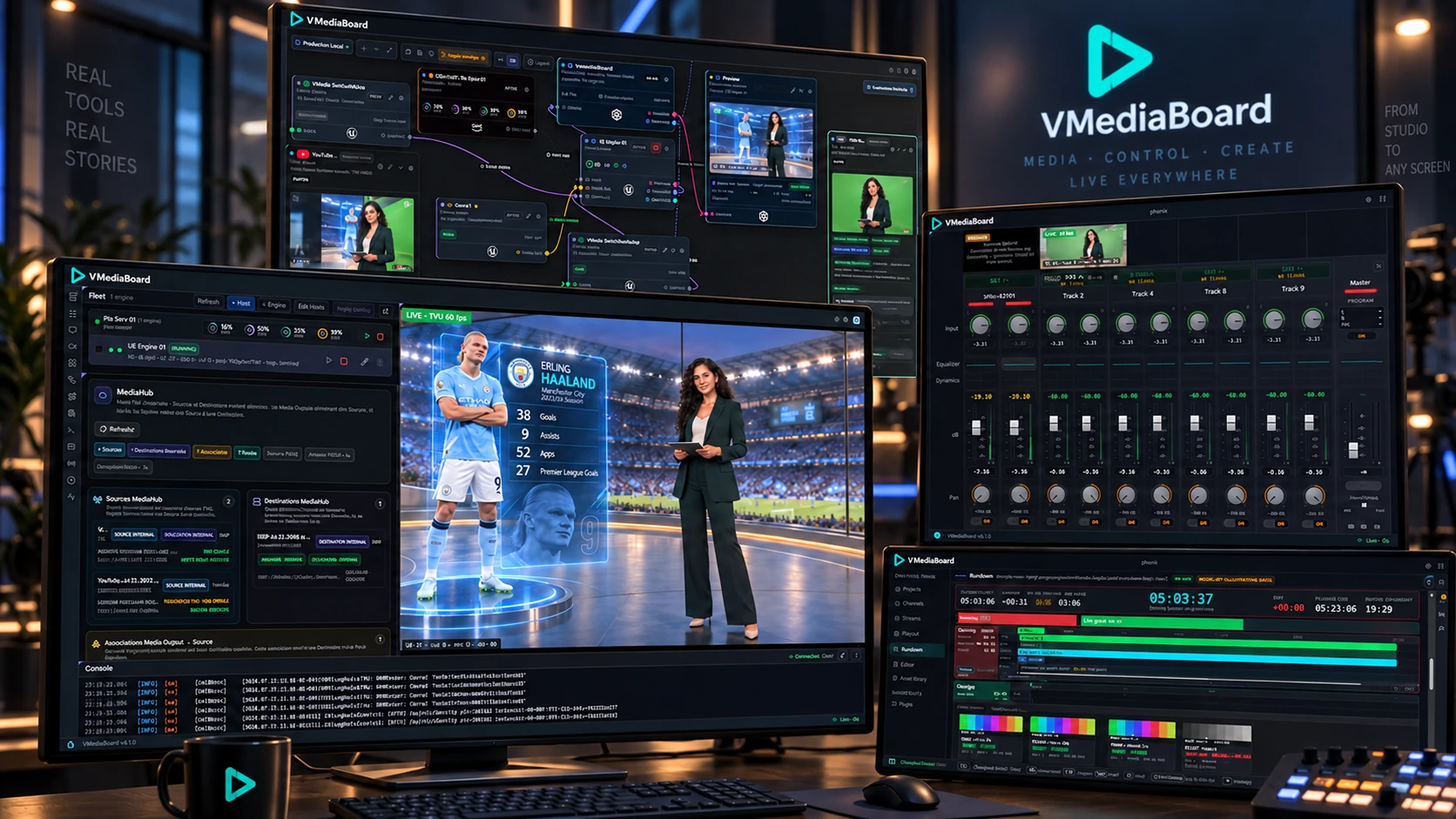
The world of television and film production has seen a revolution driven by Virtual Production and Extended Reality (XR) technologies. At the heart of this shift, engineering solutions are rewriting the rules of broadcasting from behind the curtain, and among the most notable is what Pixelstorm LLC FZ offers; it is a UAE company. The system delivers a dual solution that links democratic access for independent content creators with the strict standards of television broadcast networks, drawing on the flexibility of its data processing and its advanced software architecture.
When a user looks for the first time at a system such as VMediaBoard (Virtual Media Board), they may take it for a mere smart control panel or a software interface for changing backgrounds on giant LED walls. The technical reality goes much further: this system is the Orchestration Platform that runs the entire production environment, linking video sources, audio processing and graphics engines to give a complete, real-time view of everything happening in the studio, through complex live-broadcast processing that includes video decoding and encoding and audio mixing on advanced servers that carry the data with the lowest possible latency.
🧬 Adapting the DNA of virtual production: carrying visual competence into smart pixel processing
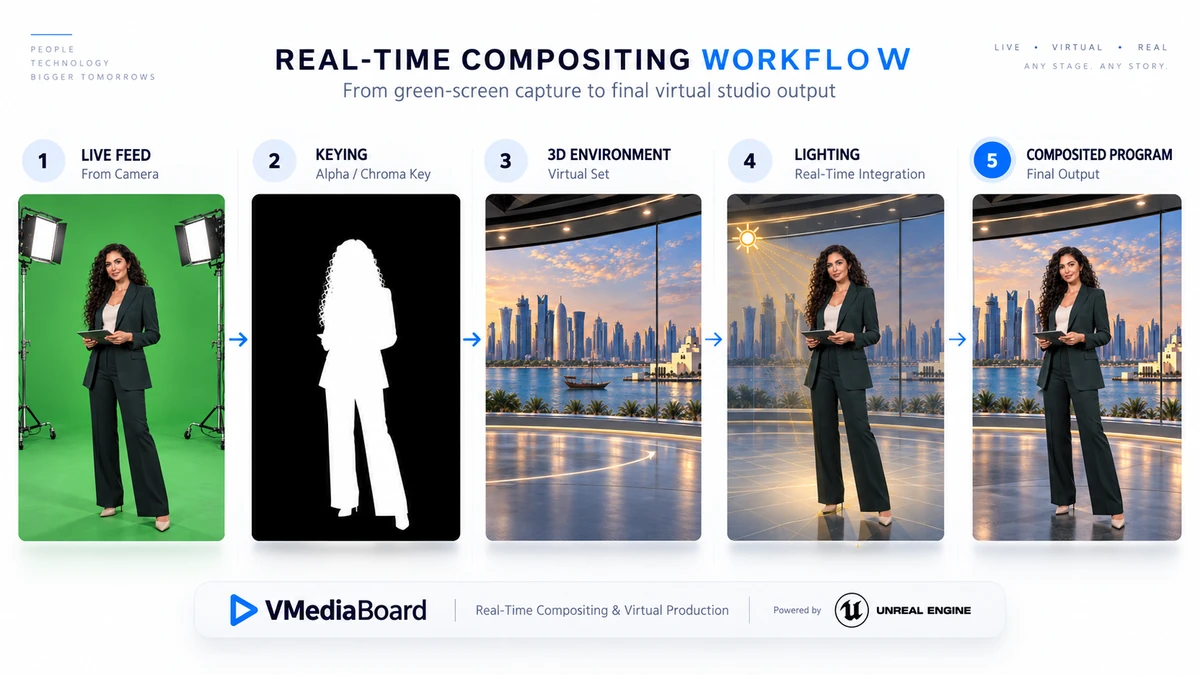
Pixelstorm adopted the core rules of the "DNA" of advanced virtual production, but through a different engineering philosophy built on proprietary software integrated under the name VideoSurfaceTSR. Where conventional systems in mixed reality (MR) and virtual reality (VR) environments project the presenter as a flat layer over the graphics, Pixelstorm integrated the live feed as a fully physical element inside the render engine:
- Instant physical interaction: the live video feed is integrated as an interactive element inside Unreal Engine, which lets it interact directly with the digital lighting and generate accurate shadows and reflections, and respond correctly to the lenses' depth of field.
- Precise pixel processing and isolation: complex details (such as flyaway strands of hair and soft shadows) are isolated and processed pixel by pixel (Pixel-Perfect Integration) to guarantee a coherent physical integration without straining the graphics cards.
- Digital set extension: the ability to extend the 3D graphics seamlessly beyond the physical bounds of the tangible LED screens in the studio, exactly matching the real camera angles.
1️⃣ The democratic side: empowering content creators and independent studios (Democratization of Content Creation)
The high capital cost of virtual studios has long been a barrier for independent producers, regional channels, universities and content creators. Here the democratic side of the Pixelstorm system appears: it moves the entire production load to the cloud infrastructure so that distributed teams can collaborate remotely without needing local computers with extreme specifications:
- No huge upfront investment: costly local hardware is replaced by giant GPU render servers on platforms such as AWS, spun up and torn down with complete flexibility as needed.
- The Quality-as-a-Service model: the system lets a content creator rent superior cinematic processing power only for the duration of their episode's shoot or live broadcast, and pay according to resolution, framerate and the number of hours consumed, through a system of points or digital tokens. This model turns heavy fixed costs (CapEx) into flexible, direct operating costs (OpEx).
2️⃣ The enterprise side: structural stability and privacy for major television stations (On-Premise & Hybrid Enterprise)
On the other side, news channels and major broadcast networks set strict standards about exclusivity of information, data security and uninterrupted connectivity. So the system is not limited to the public cloud: it supports hybrid cloud and full on-premise installation inside the channels' data centres, guaranteeing absolute sovereignty over content.
To guarantee total reliability while on air, the system relies on a Kubernetes environment to manage and distribute the software workloads across the internal servers, which gives stations decisive advantages:
- Security and complete isolation: operational processes are isolated and the live feed is secured inside the channel's closed network.
- Smart, instant recovery from errors (Auto-Healing): if any sudden software error occurs in any of the system's containers, Kubernetes automatically reinstalls and restarts the affected part within fractions of a second, without interrupting the broadcast and without complex manual human intervention.
🐧 Native Linux efficiency (Linux-Native) versus the complexity of Windows
While many competitors on the market rely on hybrid solutions or on Windows operating systems alone to run their software (consuming hardware resources and paid licence costs), the Pixelstorm system stands apart in being built entirely, 100%, on a native Ubuntu Linux environment.
This engineering choice lets Unreal Engine run in "headless rendering" mode (Headless Rendering or Render Offscreen), where all the power of the graphics cards is directed to producing the final image instead of being wasted on operating-system graphical interfaces the viewer never sees.
🤖 Artificial intelligence as a proactive orchestrator (AI Agent) to secure the live broadcast
Pixelstorm goes beyond the common stereotype of artificial intelligence confined to the first generation of image generation (Image Generation AI) – which lacks engineering control mechanisms. Instead, the system redefines the role of artificial intelligence, moving it from a mere visual generation tool to a software orchestrator and proactive support agent (Orchestrator & Predictive Agent) inside the live, real-time production environment (Live Production).
This intelligent agent, powered by advanced technologies such as Cloud Fable 5.1 and ChatGPT Astra, can read the studio's infrastructure in real time by connecting to Model Context Protocol servers (MCP Servers) built on a robust infrastructure written in Python.
This connection gives the agent a decisive preventive role: it does not only execute visual editing commands and coordinate media, it predicts potential technical problems and software faults before they occur on air. By analysing performance indicators and the real-time flow of data, it acts as a first line of defence that protects the engineering environment from sudden stoppage, providing a highly secure interactive broadcast environment that gives directors and engineers absolute operational confidence during the live broadcast.
The practical conclusion this system offers to both branches of the media sector meets in one operating rule: less money spent on running machines, and greater investment and reliability in producing the quality of the final visual pixel on screen.
Share this article
Articles
Read next

Pixelstorm officially launches the VMediaBoard system at CABSAT 2026 in Dubai
The media, television broadcasting and mixed reality technology sector across the Middle East, Africa and South Asia turns to the Dubai Exhibition Centre, host of the 33rd edition of CABSAT 2026 from 5 to 7 October 2026.

🧬 The philosophical core of virtual production: carrying visual concepts into smart pixel processing
The engineering vision of the VMediaBoard system is not limited to managing the software infrastructure; it extends to adapting the core concepts and fundamental philosophy of advanced virtual production.
🔍 The engineering challenge: the problem of overlap and ghost shadows (The Ghosting Effect)
Despite the formidable power of Unreal Engine in simulating shadows, transparency and real-time physical reflections, its default reliance on Temporal Super Resolution (TSR) algorithms puts broadcast system developers in front of a well-known technical dilemma.