
Rendering
🔍 The engineering challenge: the problem of overlap and ghost shadows (The Ghosting Effect)
Despite the formidable power of Unreal Engine in simulating shadows, transparency and real-time physical reflections, its default reliance on Temporal Super Resolution (TSR) algorithms puts broadcast system developers in front of a well-known technical dilemma.
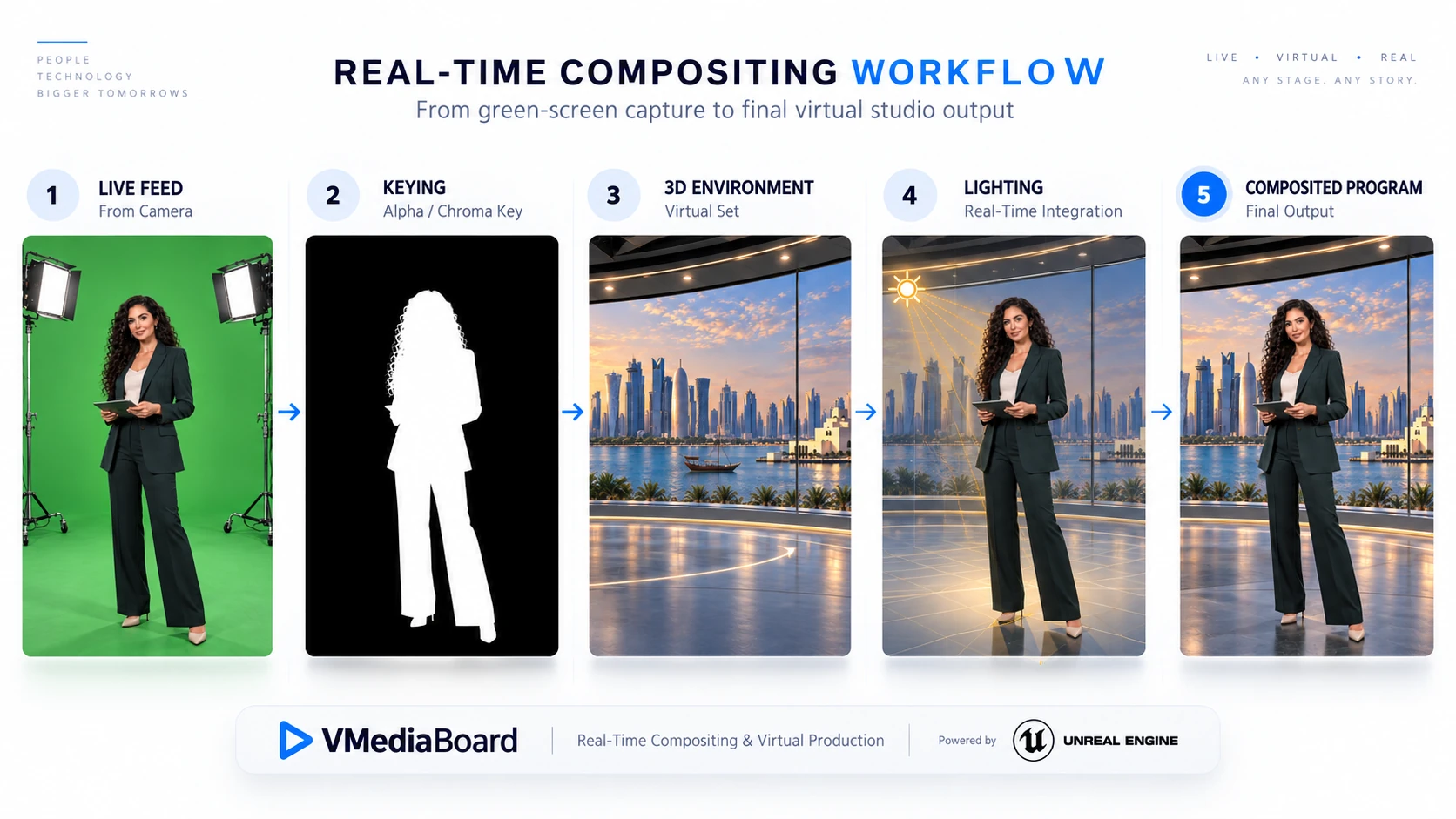
Despite the formidable power of Unreal Engine in simulating shadows, transparency and real-time physical reflections, its default reliance on Temporal Super Resolution (TSR) algorithms puts broadcast system developers in front of a well-known technical dilemma. When a real live element (such as the presenter or host coming from the actual camera) is brought in and composited into the virtual environment, the engine's temporal processing algorithms cannot accurately distinguish between the camera's movement and the presenter's live movement.
This engineering shortfall immediately produces what is technically known as the ghosting effect. This visual distortion appears as delayed, blurry shadows around the edges of the presenter's body, a clear smear that blurs the features of their face, and visual artifacts and colour bleeding at real colour boundaries, which completely spoils the quality of the final composition and severs the viewer's eye from the realism the producer aspires to.
💡 Pixelstorm's software philosophy: temporal decoupling to guarantee pixel purity
Because the game engine alone cannot output a final composition free of these visual flaws without structural intervention, the players in this field have raced to offer different treatments. The genius of Pixelstorm's software philosophy lies in developing the VideoSurfaceTSR tool, which introduced a smart separation in the pixel processing pipeline:
- Separating the video's temporal pass: the system disables the temporal TSR processing on the pixel area reserved for the real presenter inside the engine, while keeping it for the surrounding virtual set. This prevents the engine from recomputing previous frames for the presenter's face and body, and completely eliminates ghosting and visual smear in real time.
- Integrating the lighting without distortion: this technique ensures the presenter keeps receiving the shadows, reflections and direct influence of the virtual studio's digital light, but as a pure, independent physical pixel that is not subject to the set's cinematic pipeline, which preserves sharp features and the purity of true colour measurements with total accuracy.
- Resolution decoupling: the system processes the presenter's live feed at the camera's actual native resolution (such as 4K), while the complex virtual set is rendered at an operating resolution suited to the render server's performance, guaranteeing the highest quality for the composited image and absolute stability in frame pacing.
With this eloquent software treatment, Pixelstorm turned the system from a mere operating intermediary into an engineering partner that tailors the world's render engine to the strict, specific standards of live television broadcasting, giving channels and content creators the ideal balance between the beauty of the imagined picture and the purity of the real, live frame.
Share this article
Articles
Read next

Pixelstorm officially launches the VMediaBoard system at CABSAT 2026 in Dubai
The media, television broadcasting and mixed reality technology sector across the Middle East, Africa and South Asia turns to the Dubai Exhibition Centre, host of the 33rd edition of CABSAT 2026 from 5 to 7 October 2026.
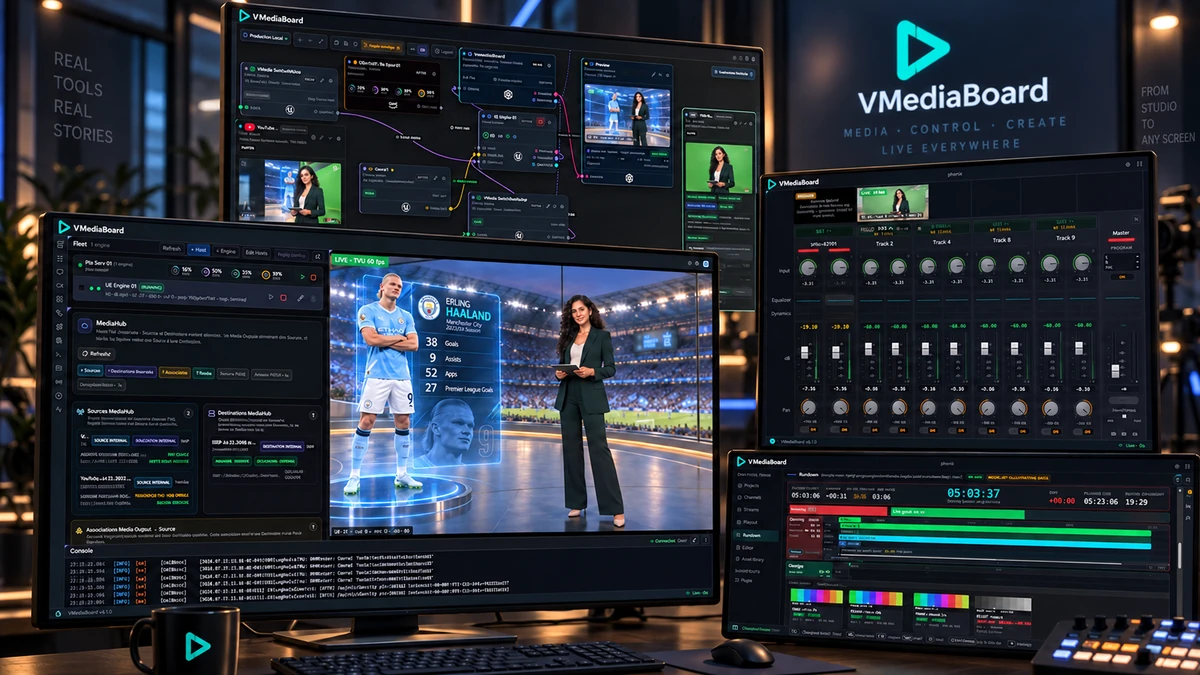
How did Pixelstorm solve the hard production equation? Advanced cinematic quality with cloud flexibility and stable in-house engineering
The world of television and film production has seen a revolution driven by Virtual Production and Extended Reality (XR). At the heart of this shift, engineering solutions are rewriting the rules of broadcasting from behind the curtain.

🧬 The philosophical core of virtual production: carrying visual concepts into smart pixel processing
The engineering vision of the VMediaBoard system is not limited to managing the software infrastructure; it extends to adapting the core concepts and fundamental philosophy of advanced virtual production.